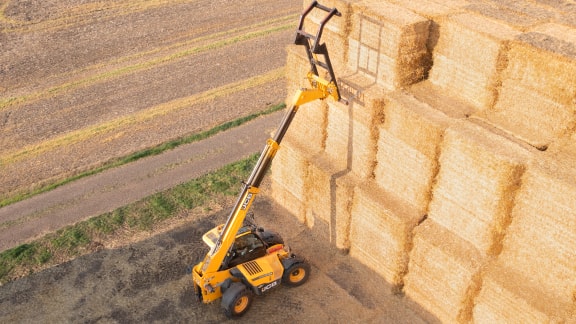

Manitou, Merlo and JCB telehandlers remapped on-site by our network of 400+ trained and authorised agents. Bespoke calibrations written in-house since 2014, every one backed by a lifetime warranty.
The Busiest Machine In The Yard
On most farms and sites, the telehandler works more hours than any other piece of equipment in the yard. It loads in the morning, feeds at midday, shifts pallets in the afternoon and buckrakes the clamp in the evening.
That workload is why the factory map on telehandlers has room for improvement. Manufacturers calibrate for a global market, a spread of fuel qualities, long service intervals and an emissions test cycle that looks nothing like a British farmyard in February. What comes out of the factory is a compromise, but the machine is capable of much more.
Two Jobs From One Engine
A telehandler is unusual because it asks the engine to do two things at once. The transmission is pulling the machine forward while the hydraulic pump is lifting, crowding and extending the boom. On a tractor, the drawbar load is steady and predictable. On a telehandler, it arrives in a spike, usually at the worst moment: boom out, load on the forks, machine climbing the ramp into a shed.
That is the moment operators complain. The engine bogs, the boom slows, and ten seconds a cycle adds up fast over a day of loading. We optimise fuelling, torque limiters and injection timing to build torque lower down the rev range, so the machine holds its revs through the lift and finishes the cycle without the operator waiting on it.


The Smart Business Case For Telehandler Remapping


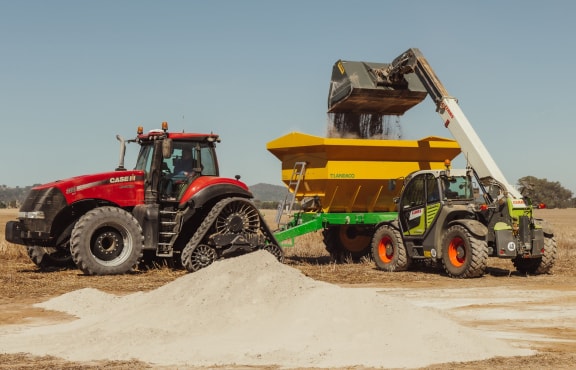
Whether the machine is on a farm, in a hire fleet, or on a construction site, the telehandler is almost always the thing everything else is waiting on. Faster cycles mean more loads moved per hour, and that shows up in what the machine earns.
The fuel case is strongest where the engine is working hardest. Loading at height with a full bucket, muck work, buckraking a clamp, running loaded up a yard ramp: this is where a cautious factory map burns fuel holding revs it does not need to hold. Across our heavy-duty work, we see fuel efficiency improvements of between 5% and 15%, and the machines at the top of that range are the ones spending their day under load.
For contractors and hire fleets, the argument is sharper. A telehandler that finishes a job in four hours instead of five is a machine you can send somewhere else the same day. For operators running mixed fleets, remapping the underpowered handlers brings them closer to the bigger ones, reducing time lost deciding which machine goes to which job.
Our calibrations are written around the whole machine. Transmission limits, hydraulic pump capacity and cooling capability all frame what we will and will not ask of your telehandler.
None of this is worth having if the machine spends the following week in a workshop. Our maps never sacrifice reliability for performance. We work within the manufacturer’s own tolerances for exhaust gas temperature, rail pressure, and torque limits, and we will hold back on power before we hand back a machine that will not maintain the reliability you need.
Understanding Telehandler Engine Platforms
The most useful thing to know about telehandler engines is how little the hardware changes between power outputs. Manufacturers build a small number of blocks and separate the models on software, turbo specification and emissions calibration. The evidence sits in our own model coverage.
Manitou’s 3.6 litre block carries the MLT range across a wide spread of outputs: 105hp in the MLT 630 and MLT 733, 120hp in the MLT 735, 127hp in the MLT 737, 133hp in the MLT 635 and 134hp in the MLT 741. Same displacement, five different ratings. The 4.5 litre block does the same thing higher up, running 115hp and 138hp in the MLT 840, 134hp in the MLT 841 and 135hp in the MLT 1040.
The construction and rotating machines follow the same pattern. The MT range spans the 3.3 litre MT 625 and MT 930 HA at 74hp through to the 4.5 litre MT 10055 XT at 114hp, and the MRT rotating handlers run from the 3.4 litre MRT 1840 to the 5.1 litre MRT 2550. Legacy Tier 3 machines are covered too, including the 4.4 litre MLT 741.
Merlo splits its range across more blocks than most. The 2.5 litre engine runs at 75hp across the P27.6, P30.10, P35.11 and the P40 Panoramics. The 3.6 litre appears at 102hp in the P40 Plus machines, 113hp in the TF33.7 CS, 115hp in the P50.18 Plus and P72.10 Plus, and 136hp in the MF34.7 and MF34.9 Multifarmers. The 4.5 litre tops the range at 168hp and 170hp across the P50.18, P65.14 HM, TF50.8 and the MF40.9 CS, MF44.7 and MF44.9.
Merlo also uses Kubota power in the 3.8 litre TF32.6 and P32.6 TT at around 100hp, and the 4.1 litre TF P55.9 CS sits at 154hp. Our platform covers the Turbofarmer, Panoramic and Multifarmer ranges through Tier 4, Tier 4F and Tier 5.
JCB builds its own engines, and its 4.4 litre block is the clearest illustration of the point. On our platform it appears at 75hp in the 531-70 and 536-70, at 100hp in the 535-95 Agri, at 109hp in the 526-56, 527-58 and 536-60, at 110hp in the 531-70 and 535-95, at 125hp in the 535-125 and 541-70, and at 145hp in the 536-70, 537-70 and 538-60. One block, 70hp between the lowest and highest factory ratings. The 4.8 litre in the 560-80 sits at 145hp.
A machine rated at the bottom of that spread is usually running hardware engineered to handle far more than it is being asked to deliver. That is where the headroom comes from, and it is why the lower-rated variants in a range often respond best.
Every Machine Is Quoted On Its Own Merits
We do not publish one set of figures for telehandler remaps, and there is a reason for that. Look at the ranges above, and you will see the same model number appearing at two or three different power outputs, on different Tier stages, sometimes with different engines. A 531-70 can be a 75hp machine, a 110hp machine or a 145hp machine. Quoting one number for "a 531-70" would be meaningless, and quoting an average would be worse.
We will tell you what your specific machine will do. Give your local agent the model, engine, and emissions stage, and we will come back with what our R&D team has developed for that exact variant and where you will notice it in the work.
Our in-house file writers develop bespoke calibrations for individual variants, which is why we can be specific about your machine instead of vague about the range.
Contact us
How We Remap Your Telehandler

Agreed Performance Gains
A tractor can be measured on a PTO dynamometer. Most telehandlers cannot, so we start somewhere more useful. Your agent will talk through where the machine is underperforming and agree on what success looks like before we write anything. You then judge the result on the work the machine actually does, which is the measure that matters to your business.

The Health Check First
Before any work starts, we run a full diagnostic health check. If the machine has a logged fault, a failing sensor, or an injector on its way out, remapping will not fix it. We will tell you what we have found and what needs to be done first.

Your Original Map, Saved
We read and back up the original calibration to a dedicated server before we write anything. It stays there permanently, so your telehandler can go back to factory settings at any point in its life, whether that is next month or three owners from now.
Loading The New Calibration
We load the calibration developed for your engine variant, then check the machine over and run it through its work. Most telehandlers are finished within a few hours and back in the yard the same day.

Flexible Service For Telehandler Operators
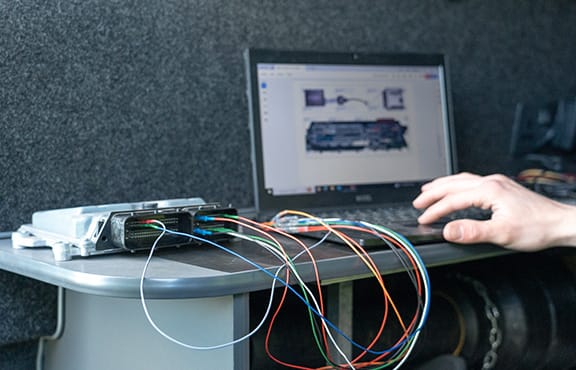
Almost all of our telehandler work happens at the customer’s premises. Our agents come to the farm, the depot, the plant yard or the site compound with everything they need, and the machine goes back to work when they leave. For a telehandler, that is usually the only sensible option, because it is the machine the rest of the operation depends on and nobody can spare it for a day on a low loader.
If you are not too far from our HQ just outside Bristol, you are welcome to bring the machine to us instead. For operators in the South West, that is often the easier route, particularly for anything unusual our R&D team wants to look at directly.
For hire fleets and larger contractors, we can schedule several machines together so you are never short on handlers while the work is done.


Become An Authorised Telehandler Remapping Agent
Telehandlers are used across agriculture, construction, plant hire and industrial handling, making them among the most commercially useful machines an agent can cover. If you already service or supply handling equipment, remapping is a natural addition to your offerings.
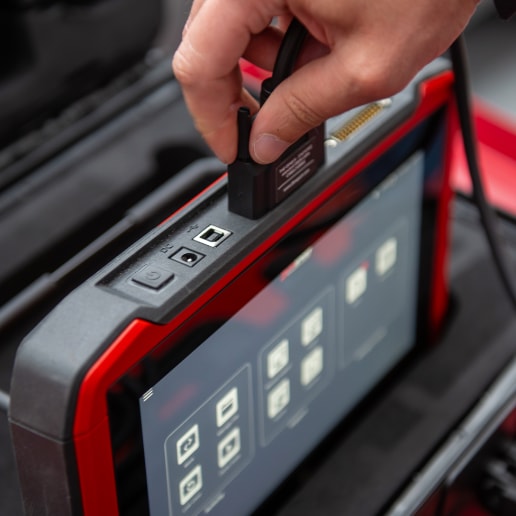
Our agents are trained and supported from our UK headquarters and equipped with field-proven tools. We are the sole UK distributor for Dimsport dynamometers, and we supply the diagnostic and remapping equipment our agents use, backed by a UK R&D team that has been developing heavy-duty calibrations since 2014.
We are selective about who we take on. We are looking for qualified engineers and equipment specialists who already have the operators' trust in their area.
Trusted By Farms, Contractors And Plant Fleets
- Remapping heavy-duty machinery since 2014
- 400+ trained and authorised agents, UK and international
- Lifetime warranty
- UK-based R&D team writing every calibration in-house
- Original maps backed up on a dedicated server and reversible at any point
- Full diagnostic health check before any work begins
Common Questions About Telehandler Remapping
A remap is a modification to the engine software, and manufacturers may deny warranty claims related to it. Your original calibration is backed up on our server and can be reinstated at any time, which most operators do before a dealer visit or a return to a leasing company. If the machine is still under manufacturer warranty, talk to your agent first.
No. We calibrate within the manufacturer’s own limits for exhaust gas temperature, rail pressure, and torque, and we account for the transmission and hydraulic systems rather than treating the engine in isolation. Machines we mapped years ago are still working hard today.
That depends on your exact variant. The same telehandler model can leave the factory at several different ratings, so we quote on the specific machine. Your local agent will tell you what our R&D team has developed for your engine and emissions stage.
Between 5% and 15% on most machines. The biggest savings come from handlers working hard under load: loading at height, muck work, buckraking, anything where the engine is holding on.
Telehandlers have no PTO to measure through, so we agree what success looks like with you before we start. Your agent will ask what the machine is struggling with, whether that is lift speed, travel under load, cycle times or fuel, and that is what you judge the result against once it is back in the yard.
Typically within a few hours, and yes, on-site is how most of it is done. Our agents work on-site at your premises, and the machine is back in operation the same day.
Completely. Your original calibration is saved to our server before we start and can be reloaded at any time. Nothing is physically added to the machine, so there is nothing to remove.
Very likely. Our in-house team writes calibrations for machines we have not covered before. Tell us the model, engine size and emissions stage, and we will tell you where we are with it.

Telehandler Remap Database
Every telehandler in our remap database, across Manitou, Merlo, JCB, Case IH, Claas, New Holland and more, with stock and remapped power and torque figures. Search by make, model or engine, or filter by manufacturer.
Machines we cover but have not yet published figures for are marked Under Development. If yours is one of those, or is not listed at all, contact our R&D team to discuss a custom remap.
154 engines
No Telehandlers match .
Ready To Get More From Your Telehandler?
Tell us what you run and where you are, and we will put you in touch with your local authorised agent.